The Foliat Manifesto
Introducing The Hypertree Foliat (Or foliat, for short)
A brand new digitally born literary format invented by the writer Flavius Gaius. Meant to be experienced through a website, hypertree foliats are self-contained, nested, and hyperlinked chapters and sub-chapters, meant to be freely navigated by readers in any way they choose.
What are hypertrees, and what is a foliat?
A hypertree is a new form of literary product. Each work of hypertree is known as a foliat. Check out the picture below of a node tree and a node graph.
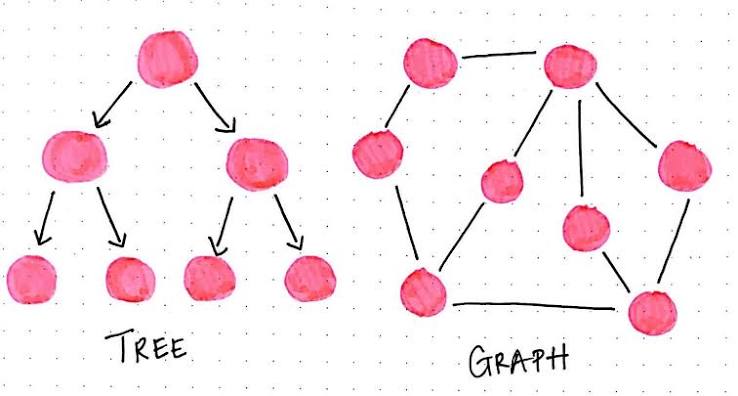
A foliat, or a work of hypertree, combines these two concepts. The literary work itself is populated like a node tree (picture on the left), but is also hyperlinked back to itself throughout as a graph (picture on the right). The result is a highly multi-dimensional reading experience in which the layers of the story build and compound upon one another, linking forwards and backwards at will to different contexts, information, backstory, and extenuating circumstances.
Each chapter of a foliat is called a node, and can be any length, but is best done as a short entry (500-1000 words). Each series of linked sequential nodes is called an edge. Edges have a series of nodes (chapters) that can then link off to deeper edge node levels from any node in the edge (this is the classic node tree structure observed above). The result of the hypertree experience is time spent immersed in a growing story that grows as a linear, non-linear, and multi-dimensional experience all simultaneously.
Is this just Choose Your Own Adventure? (CYOA?)
No, because there is no pretense to linearity. A hypertree has no technically correct storyline, but taken altogether, it tells a complete story. CYOA stories are still linear stories at heart, but gamifying the reading experience to give the sensation of dynamic change. This gamification also takes a CYOA story out of the realm of literature, into the realm of games (the reader cannot help but feel that there is a right or wrong, best or worst set of choices to make, no such trade-offs exist with the foliat, because a foliat is not a CYOA).
How it works
Foliats use hypertree structure to turn the CYOA story concept completely on its head. You as the user, and reader, are free to navigate, advance, backtrack, meander, or storm through a hypertree in any direction you choose. All the while, the hypertree structure of the foliat remains stable. You can observe the hypertree from above, noting its clear logical edges (node levels) and their particular nesting, and then dive into the story any way you choose. Once entered, the story can be navigated by both a) a story link compass that navigates the story in up to four different dimensions (directions, edge levels), and b) hyperlinks within the nodes referencing and clickable (navigable) to other nodes, both sibling and non-sibling (continuous or non-continuous). Every edge begins at the first node and then proceeds "downwards." You can choose to follow the set logical flow of the sub-node level you're on to completion, navigate down (to the right) to the next sub-edge level at any point, or choose to link out to a completely different node that might be at a completely different edge level and timeline of the story.
While a new concept that might appear daunting at first, foliats are meant to follow internal logical edges (levels) that build related, contiguous portions of the story that, when taken as a whole, build out a discernible central, linear narrative. The freedom of navigation through the story means that every reader will have a different experience at different times while engaged with the narrative, but never the wrong experience. There is no winning or losing, like in the case of a CYOA game, but there is also never a strict constraint that the story be experienced exactly the same way that every other person experiences it. Still, the structure of the foliat hypertree makes it so that, despite how freely traversable the tree and node graph is, it is still highly shareable, with mentioned structured logic throughout that is discernible and consistent. If a group of readers wanted, they could easily read the story in the same way, in the same directions, at the same time. The difference is they are not constrained as a group to just this reading of the foliat. In that sense, they can choose their own hypertree path, and have their own unique experience of the foliat story, but they will never be distracted by a sense that there's a game they should be focused on winning, because a foliat is literature, not a game.
From Flavius Gaius:
"Hello everyone, thank you so much for your support. I designed hypertrees after many years of contemplation about the future of media and literature, and concluded that the linear novel format has become obsolete. While we exist in this digital reality, we can never go back to older forms of literature that existed before the speed and depth of information we come to expect from our digital devices became commonplace. This is the idea and purpose behind foliats, to leverage the best elements of HTML and hyperlinking technology to create new literary structures that both satisfy, engage, and delight the modern mind. I hope you enjoy my hypertree foliats, Shards and Fragments. I greatly enjoy creating these and I look forward to writing many more."